
Your customers already told you
how to sell more.
Your customers already told you how to sell more.
I marry what your customers say with what they actually do, then turn it into the personas and actions that increase revenue.
YouTube video here
Some of the 4,000+ brands I've worked with
AG1 // Kosmos Q // Cymbiotika // Freak Athlete // Ancestral Supplements // Victoria Beckham Beauty // G FUEL // Frankies Bikinis
And what they say...
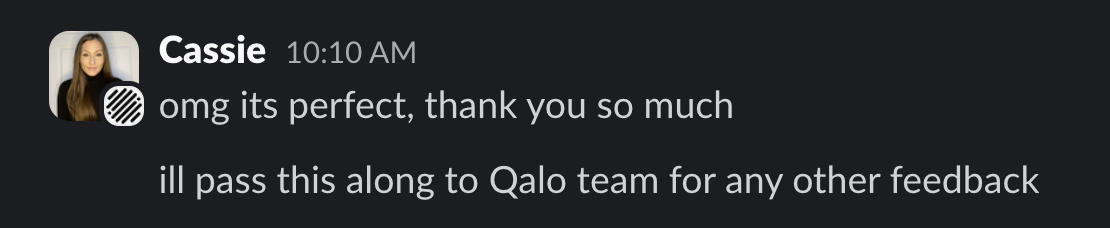


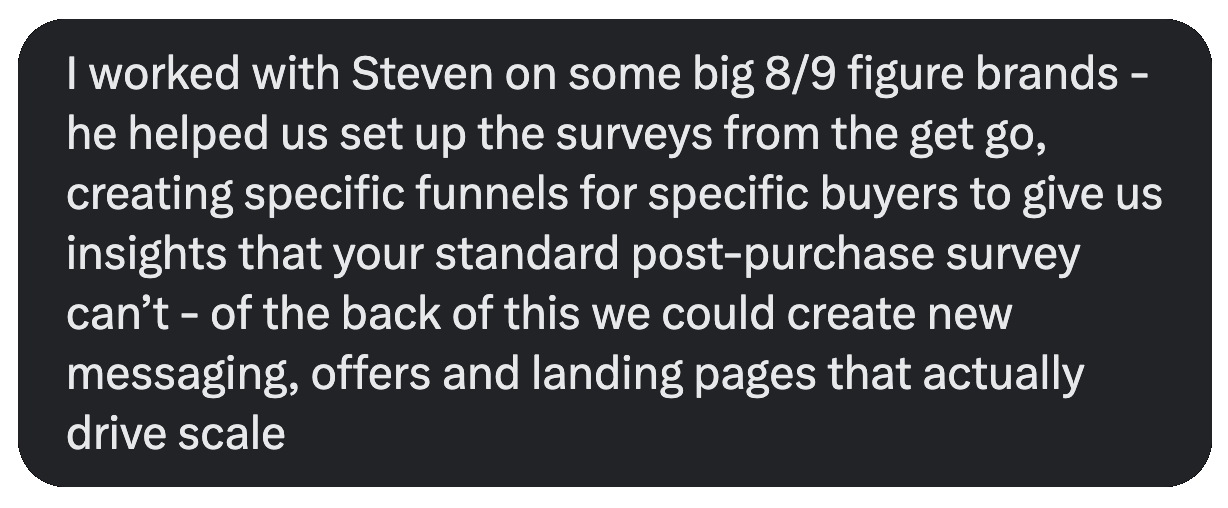
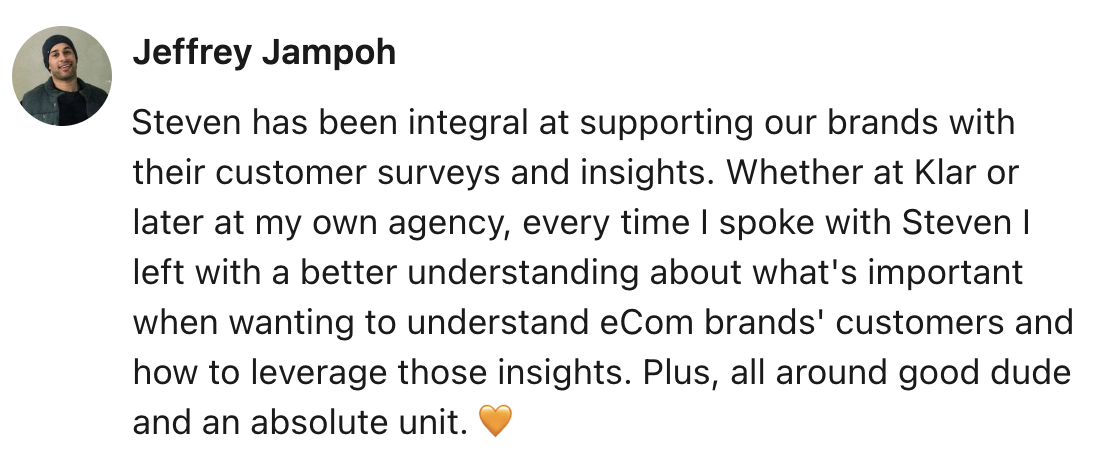
Partners who recommend us

Three problems I see at most brands
01
Don't know what to ask
End up asking 1-2 questions and rely on CVR + CTR to guide the rest of decision...
02
Don't know how to analyze
Feedback is scattered across teams + platforms and never married to revenue.
03
Don't know how to act
Once feedback is collected, teams don't know how to turn it into revenue.
Ways to work together
Want a hand, or want it done for you? Start with whichever fits.
Customer intelligence audit + design
For brands that have never run surveys, or aren't sure who their customer really is. I audit the customer voice you already hold, then set up the right research design for the decisions you're trying to tackle. With an action plan to use yourself or evolve into an ongoing engagement.
*About five weeks.
Ongoing research
For the brands that have a ton of customer language, but no one to action it. Finally have someone be your brands customer intelligence partner. Designed around the experiements and million dollar decisions you're trying to make with just a hunch.
*3 month minimum. Each cycle compounds.
What true customer intelligence unlocks...
- Personas your team can actually market to (kept current)
- More creative diversity that stays on-brand
- Authentic creator briefs built on your customers’ best-selling words
- Post-purchase flows that grow lifetime value
- A clear read on why your highest-value customers stay
How it works
1
Analyze what exists
Reviews, survey answers, support tickets, ad comments read together and tied back to customer revenue and their actions in Klaviyo.
2
Gather what's missing
Design surveys, call customers, audit competitors, and use social listening to get the evidence until confidence is met.
3
Organize evidence
Take the new language, conversations, and data and match it against revenue for a clear read out.
4
Turn it into action
Take the new findings and deploy as tests across brand. Whether as ad scripts, email flow suggestions, PDP changes, or whereever the new finding can make an impact.
Customer intelligence toolbox
Tool
What it does

Zigpoll
Asks the questions.
On-site, post-purchase surveys, and NPS surveys, designed for the decisions you're trying to make, so the answers are usable the day they come in.

Alia
Understand pre-purchase shoppers.
Pop-ups that ask one question while people browse, so we can gain insights throughout the whole funnel.








Your stack
Reads what you already have.
Orders, email clicks, reviews, surveys, ad comments, and support tickets from the tools you already use. Nothing to migrate.


Calls
Connect with customers.
Short customer interviews over Google Meet or phone to dive deeper into the intelligence we're looking to capture.

Signal
Connects the answers.
Our research tool. It brings your surveys, reviews, support tickets and orders into one place and ties what customers say to what they buy to find insights that drive revenue.
Using different tools? Not a problem. We connect to most major support, review, and survey platforms.
Free resources
I just want brands to be more customer-centric again.. so please take these if they're helpful for you.

About
For the last 3.5 years, I’ve focused on one thing: helping brands stop making million-dollar decisions without their customers’ voice.
As the former VP of Customer + Revenue at KnoCommerce, I worked with more than 4,000 brands and agencies on their surveys and insights.
The same problems came up again and again. Brands didn’t know what to ask, how to analyze the answers, or how to turn them into growth.
So I went beyond surveys. I take everything your customers say and marry it to the revenue those customers bring in, so your next ads, emails and customer relationships speak their language.
Questions
What does working together look like?
Once we've chosen the right engagement, we'll agree on the decisions you're trying to make and what you most need to learn. Then I connect and analyze all of your existing customer language against those decisions, show you what you already know, and design the research to close the gaps so you can decide with confidence. We'll work together in Slack, with calls on a rhythm that fits the engagement.
Do we only get insights on the decisions we're evaluating?
No. Research always turns up more than it set out to answer. When we find something outside the scope that could lead to growth, we'll share it with you. We just don't build the engagement around those extras, so the work stays focused on the decisions you brought us in for.
Is this just for brands?
No. Signal is built with brands in mind, but the thesis came out of agency partnerships and the value there is just as strong. The same evidence gap shows up across a whole client roster rather than one brand. If you are an agency, say so when you get in touch and we will talk about your roster rather than a single brand.
We already survey our customers.
Good, keep running it. Whatever platform you use, Fairing, KnoCommerce, Zigpoll, Okendo, Alia or your own post-purchase flow, we work inside it and start from the responses you already have. Survey and research design is a large part of this, and it is most of what I did for four thousand brands before Signal. The difference is what happens next: connecting those responses to what customers actually buy, and turning them into specific messaging, offers and personas your team can use. Most survey programs stop one step before the part that pays. Having one running already is the main thing that makes a brand a good fit, because I would rather spend the first weeks finding growth than building a research program from zero.
We already know our customer.
You probably know them better than I will for the first few weeks. The question is not whether you know your customer, it is whether you know which of the things you believe about them actually changes what they buy when you put it in front of them. Those two overlap less often than anyone expects, and the gap is usually worth real money.
How much work does this create for my team?
The biggest thing I saw at KnoCommerce is that ecommerce brands do not have time, and they care about the revenue result far more than handholding a partner. So this is built to take almost none of yours.
- Week one, about 30 minutes. Getting us access.
- Week two, about an hour. Walking through the first read together.
- Monthly, 90 minutes. The review, with whoever should sit in on it.
- Everything in between, none. Connecting, analyzing, prioritizing and designing the research are on me.
How do you know an insight is actually driving revenue?
Every experiment we launch carries an identifier tied to the insight and persona behind it: a naming convention on ads, a tag on email campaigns, or a URL slug on landing pages. That lets us trace revenue back to the specific insight and see whether it's paying off the way we expected. Where we can, we also compare against a version without the change, so you know it's the insight working and not just a good week. Where we can't, we'll say so and treat the result as a strong signal rather than proof.
Do we have enough customer data to make this useful?
Yes. Odds are you already have more than you know what to do with, because it compounds across sources. A few hundred reviews, a year of support conversations, a survey that has been running quietly and your full purchase history is a great deal to work with, even when none of them feels like enough on its own. If you are clearly under the floor, I will tell you on the first call rather than take your money and find out in week three.
What if we already have a data team?
Then you're one of the rare few. Out of thousands of brands, I've only met six with a dedicated data team. In that case my role shifts: I run the customer research myself and act as the bridge between marketing and data, so both teams work from the same findings and act on them together.
Finally have someone who goes through all your customer language (and turns it into $$$).
You bring the 1,325,318 pieces of language.
We’ll get you the 1 clear action.
Anonymous Cmo's
237+ Agree
Most popular